When deciding to buy or sell a home, there is a crucial moment when words and handshakes give way to legal commitments. This moment is the signing of the preliminary sales contract, commonly called the "compromesso." Many consider this agreement a simple formality while waiting for the notary deed (rogito). In reality, it is the most important document of the entire negotiation: it is here that the rules of the game are established, and protections are locked in for both parties. Let’s clarify everything you need to know to sign with total peace of mind.
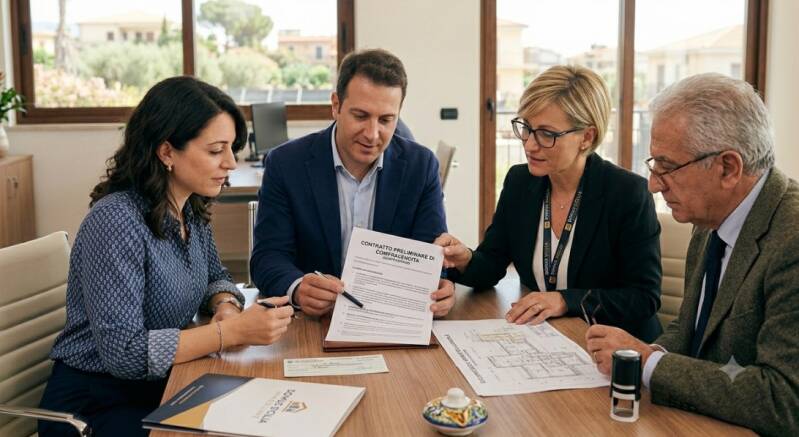
1. What Exactly is the "Compromesso"? The preliminary contract is the agreement by which the seller and the buyer legally commit to executing the final contract (the deed) by a set date.Myth-busting: The preliminary agreement does not transfer ownership of the property. The house remains the seller's until the day of the deed before the notary. However, from the moment of signing, neither party can withdraw from the deal without facing heavy economic or legal consequences.
2. What Must It Contain to Be 100% Secure? To avoid any room for doubt or interpretation that could lead to disputes, a well-drafted preliminary agreement must contain highly detailed elements:
-
Identification of the parties and the property: Full personal details, exact address, and updated land registry (catasto) data.
-
Price and payment terms: The agreed amount, the deposit paid (caparra confirmatoria), and deadlines for subsequent payments.
-
The date of the deed: The deadline (either peremptory or ordinary) by which to appear before the notary.
-
Urban planning and land registry compliance: The seller must guarantee that the property’s current state perfectly matches the plans deposited at the Land Registry and the building permits filed with the Municipality.
-
Freedom from encumbrances: Certainty that the house is free from prejudicial mortgages, foreclosures, or pending condominium disputes.
3. Registration and Transcription: Clarification These two steps are often confused, but they serve different purposes and offer different levels of protection.
-
Registration (Mandatory): Must be carried out at the Revenue Agency (Agenzia delle Entrate) within 30 days of signing. It is primarily a fiscal measure to give the contract a "certain date." It involves paying registration taxes and stamp duties (a percentage of the deposit is paid, which is then deducted from the taxes due at the final deed).
-
Transcription (Optional, but recommended): This is performed by the notary in the Real Estate Registries. It is not mandatory, but it represents a "shield" for the buyer. If a long time passes between the preliminary agreement and the deed, or if substantial deposits are paid, transcription "reserves" the purchase. This means if the seller suffers a foreclosure, has a mortgage placed, or incorrectly decides to sell the same property to a third party, the first buyer’s purchase remains sacred and inviolable.
4. Fundamental Checks BEFORE Signing The biggest risk is signing too lightly, thinking "we'll fix everything before the final deed." The golden rule is to verify everything beforehand. As intermediaries, before we allow any signature, we ensure we verify:
-
Urban regularity: Checking for building amnesties, permits, and ensuring there are no abuses or discrepancies.
-
Origin of the property: If the house comes from a donation, caution is needed because many banks struggle to grant mortgages on donated properties due to the risk of future claims by heirs.
-
Condominium expenses: Requesting a certificate from the condominium administrator to ensure the seller is up to date with payments and whether any extraordinary work has already been approved.
The Choice of Peace of Mind Relying on qualified professionals means exactly this: leaving nothing to chance. At Domus Sicilia Immobiliare, we analyze every technical, urban, and legal aspect before even structuring a purchase proposal, ensuring that the path to your new home is linear, transparent, and surprise-free. Are you planning your next purchase or want to sell your property in total safety? Contact us for personalized consulting and discover how we can protect your projects.
Add comment
Comments