There is an aspect of the real estate market that often creates confusion: the difference between usable habitable surface and accessory surface. During our property searches, we frequently visit homes where taverns, finished with masonry kitchens, parquet floors, and modern bathrooms, are presented as "second living rooms" or "additional bedrooms."
Yet, very often, that dream "tavern" is officially a cellar or a storage room in the land registry. Let's look at why it is essential to clarify before spending your money.
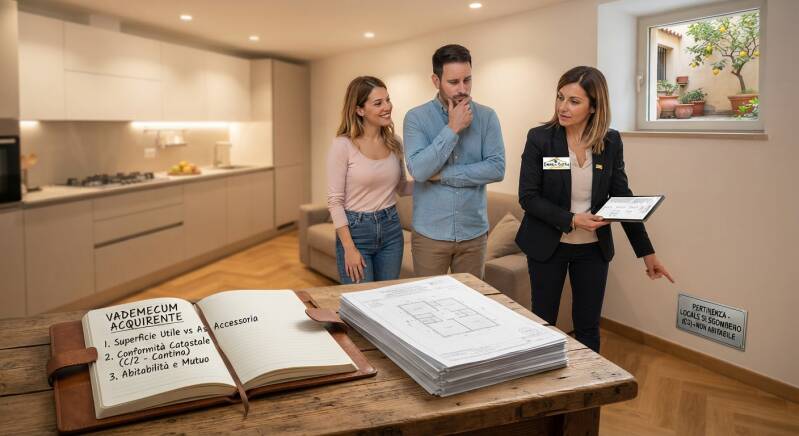
Why are they often not habitable?
During construction, builders must adhere to strict cubic capacity limits and parameters. Often, to make the project fit within the local master plan limits, taverns and basements are classified as accessory rooms or appurtenances.
-
Lack of health and sanitation requirements: Many of these spaces do not meet the aero-illuminating ratio (the ratio between the window surface and the floor surface) or do not have the minimum heights required by building regulations for residential rooms.
-
The problem of humidity and salubrity: Taverns are often underground or semi-underground rooms. Even if aesthetically well-finished, they can suffer from rising dampness or condensation issues, making them unsuitable for hosting a bedroom or an extended living area for health reasons.
The risks for the buyer
Buying a tavern passed off as habitable involves concrete risks:
-
Problems with the mortgage: The bank, through the technician's appraisal, will evaluate the property based on its official cadastral status. If the tavern is unauthorized or non-habitable, the bank might refuse the loan or grant it only on the residential part, devaluing the investment.
-
Urban planning compliance: In the event of a future inspection or resale, you might find yourself having to restore the premises to their original state at your own expense (demolishing unauthorized kitchens or bathrooms) because they constitute a building violation.
-
Insurance and resifiability: A house with an "unauthorized" room is much harder to resell and is not properly covered by insurance in case of damage.
Domus Sicilia Immobiliare's advice
A tavern can be a wonderful space for leisure, but it must be sold and bought for what it is.
-
Always check the cadastral floor plan: If the floor plan does not show a bathroom and kitchen in the tavern, it means they have not been authorized.
-
Distrust verbal promises: A nice floor is not enough to turn a cellar into a living room. Always ask for the certificate of occupancy and check the building permits.
-
Transparency pays: For sellers, correctly declaring the nature of the property avoids negotiations falling through at the last minute before the notary and protects against future claims for compensation.
Do you want to buy with the certainty of purchasing square meters that you can actually live in with full legality? At Domus Sicilia Immobiliare, we work to protect your interests, offering technical consultancy that goes beyond mere aesthetic beauty. Come visit us at the office for personalized advice.
Add comment
Comments