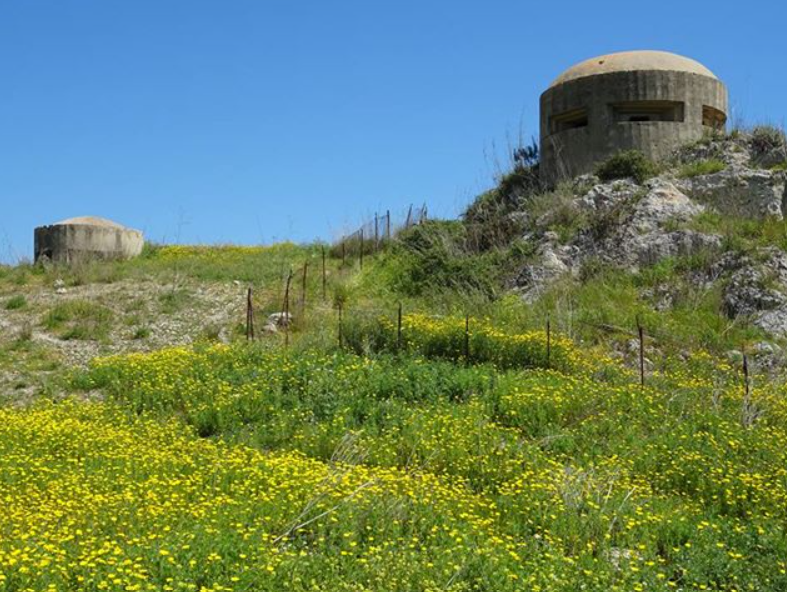
Take a walk along the Ionian or Tyrrhenian coast, venture into the inland hills, or explore the slopes of Etna, and you are bound to stumble upon unusual shapes, often swallowed by the Mediterranean scrub or semi-camouflaged among the rocks. Square blocks of reinforced concrete, watchful slits, shelters carved into lava stone: these are the pillboxes and bunkers of the Second World War, a veritable open-air museum silently dotting the landscape of our island.
Here at Domus Sicilia – Dimore e Terreni, we believe that truly knowing a land means exploring every nuance of it, even those less traveled by traditional tourism. And Sicily—a millennial crossroads of peoples and strategies—holds within its folds a history of fortifications that deserves to be told.
1. The Fortress in the Mediterranean: Why Sicily Was "Armored"
Between 1940 and 1943, at the height of the Second World War, Sicily’s central geographic position made it one of the most strategic and heavily militarized territories in Europe. In anticipation of the feared Allied landing (Operation Husky, which culminated in July 1943), the Ministry of War ordered the construction of an imposing defensive web.
Thousands of fortifications sprang up along kilometers of coastline and around major transport hubs. The objective was clear: to create a continuous resistance line to protect the island from an amphibious attack.
2. Casemates: Concrete Sentinels Between Rocks and Beaches
The most widespread structures are undoubtedly the casemates (or pillboxes): small single-weapon or squad-support bunkers designed to house machine guns and observation posts.
-
Often invisible to the distracted eyes of beachgoers, these small concrete fortresses poke out among sand dunes, right on cliffs, or integrated into the most stunning views of our coast.
-
From Trapani to Syracuse, passing through the Catania coastline, they represent the military archaeology of an era when the coastal landscape served a radically different function than it does today.
3. From Etna's Bunkers to Underground Shelters
It is not just about the sea: the inland areas and volcanic peaks also preserve deep traces of that period. Around Etna—such as in areas like Monte Po in Catania or along strategic inland communication routes—air-raid shelters and control posts were carved out and camouflaged in the lava rock.
The cities themselves, like Catania, had to dig underground (or adapt cellars and crypts) to offer refuge to the civilian population during the dramatic bombing raids of '43. These are underground spaces that today, thanks to the work of associations and scholars, are reemerging as testaments to collective resilience.
4. From Armed Defense to the Value of the Land
Today, those bunkers have lost their military function, turning into silent ruins, pieces of industrial and military archaeology that intrigue history buffs and hikers alike. Fortunately, the function of the Sicilian territory has changed radically: from a theater of conflict and barriers, our island has returned to being a place of hospitality, beauty, and quality of life.
Final Thoughts
If once the absolute priority was to armor borders and defend coasts with reinforced concrete, today the pursuit of security has shifted toward the quality of living. Choosing to live in Sicily—whether it is a historic home in a village or a detached house overlooking the countryside or the sea—meets a completely different need: finding a haven of peace, stability, and well-being in which to build one's future.
We at Domus Sicilia – Dimore e Terreni continue to look at our territory with the same love as always, ready to value every corner of it, as custodians of a millennial history that makes every home in Sicily truly unique in the world.
Add comment
Comments