There was a time when the scent of freshly baked bread did not come from the bakery down the street.
It came from Sicilian homes, farmhouses, and courtyards, where the wood-fired oven was much more than just a tool for cooking.
It was a meeting point, a workplace, and above all, an important part of daily life.
In many Sicilian homes, the oven was built of masonry, often outside the house or in a dedicated room. It was fueled by wood and reached high temperatures, sufficient for baking bread, pizzas, focaccia, biscuits, and numerous other preparations.
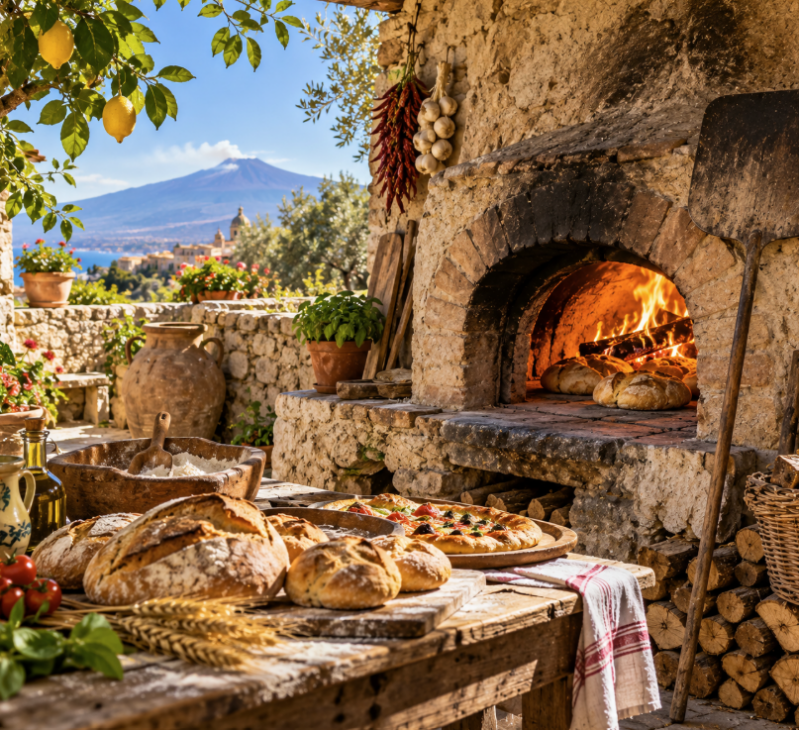
The oven was lit with wood
Preparing the oven required time and attention.
The wood was arranged inside the cooking chamber and lit well in advance.
The fire had to slowly heat the oven walls.
When the temperature was high enough, the now-consumed wood was moved or removed, and the cooking surface was cleared of ash.
At that point, the oven was ready.
There were no digital thermometers.
Temperature was assessed primarily through the experience of those who knew the oven: the color of the walls, the heat emitted, and the behavior of the flame provided precious indications.
Homemade bread
One of the most important moments was the preparation of bread.
The flour was kneaded with water, yeast, and salt, and left to rest.
The dough was then divided and shaped into loaves.
When the oven was ready, the bread was placed on a wooden peel and introduced into the cooking chamber.
Shortly after, the whole house filled with an unmistakable scent.
It was the scent of bread baking slowly over wood.
Heat was never wasted
One of the most clever features of the wood-fired oven was the ability to harness the accumulated heat.
After baking the bread, when the temperature began to drop, the oven could be used for other preparations.
Focaccia, biscuits, cakes, potatoes, vegetables, and other foods were cooked.
In this way, the heat produced by the wood was fully exploited.
It was a kitchen based on experience and care, where nothing was wasted.
The holiday oven
The wood-fired oven played an even more important role during holidays.
Christmas, Easter, weddings, and other family occasions often meant preparing large quantities of food.
The oven became the protagonist of the day.
Traditional sweets, special bread, biscuits, and dishes requiring long cooking times were prepared.
And while the oven worked, people chatted outside, waited, and shared the work.
The neighborhood oven
In some rural areas, the oven did not necessarily belong to just one family.
An oven could be used by multiple people and become a small community gathering point.
Women helped each other prepare the dough, men often took care of the wood and maintenance, and children waited curiously for the moment the bread would come out of the oven.
It was a way of living very different from today's.
Food preparation required time and cooperation.
Wood had its importance
The choice of wood was also important.
It was necessary to use properly seasoned wood suitable for cooking, avoiding materials that could produce unwanted smoke or odors.
Wood also represented a resource to be procured, transported, cut, and stored.
In the Sicilian countryside, this was part of daily work.
The oven in ancient Sicilian homes
Even today, visiting an old house, a farmhouse, or a rural dwelling, you may happen to find an ancient masonry oven.
Sometimes it is almost completely hidden.
Only a small arched opening, blackened by smoke, remains.
Other times, the cooking chamber, the chimney, and the refractory brick floor are still visible.
These are small details that tell a huge part of life from a bygone era.
A piece of Sicily that should not disappear
The wood-fired oven represents a way of living based on sharing, patience, and the mindful use of resources.
Today we can prepare bread in a few minutes, buy any food at any time, and cook by pressing a button.
In the past, however, behind a simple loaf of bread there was flour, water, yeast, hands kneading, wood, fire, and experience.
And above all, there was a family.
Perhaps that is why the memory of the wood-fired oven remains so strong in the minds of those who knew the Sicily of the past.
Because that oven didn't just bake bread. It warmed the home, brought people together, and preserved the flavor of a Sicily that today we can only remember.
Add comment
Comments