Welcome back to our weekly journey through the wonders and fortifications of the Mount Etna region. After exploring the stern Norman keep of Motta Sant'Anastasia, for Chapter 7 we head northeast, where the province of Catania meets the Alcantara River and the slopes descending toward the Ionian coast.
Get ready to discover the magnificent Castle of Calatabiano, a fortress perched high above the valley with centuries of layered history.
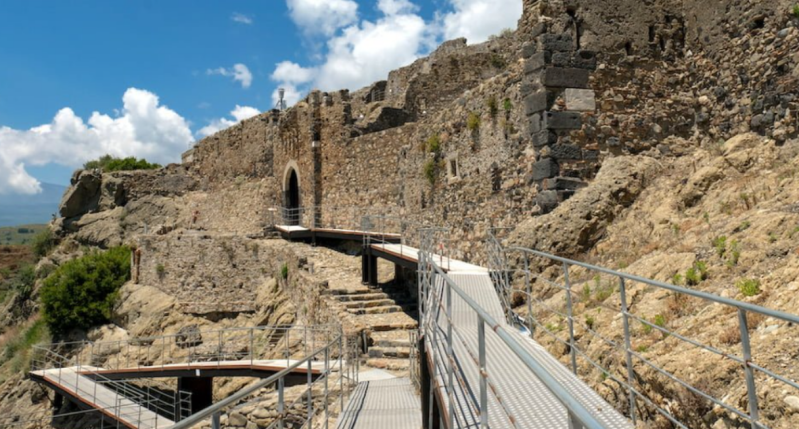
7. The Arab-Norman Castle of Calatabiano: The Stronghold Dominating the Alcantara Valley
Situated atop a steep hill overlooking the town of Calatabiano and the entire valley, this castle is an open-air history book. Its very name reveals its deep origins: deriving from the Arabic Qalat al-Biyan (the Castle of Biyan or the Shiny Rock), bearing witness to how this strategic site was contested and inhabited by various civilizations.
History: From Islamic Origins to the Cruyllas Family
The hill of Calatabiano was first fortified by the Arabs around the 10th century, as they immediately understood the crucial importance of this elevated position to control the access routes between the coast and the inland areas. With the arrival of the Normans (led by Count Roger), the stronghold was conquered and expanded further to consolidate Christian rule in the valley.
In subsequent centuries, the castle passed under the control of prominent feudal families, including the noble Cruyllas family, who transformed it into a prestigious fortified residence, enhancing and modifying it to make it more comfortable while retaining its formidable defensive structure. After a long period of neglect and decay, the castle underwent massive restoration work that restored it to its former glory.
Architecture and the Panoramic Inclined Elevator
The fortified complex combines Islamic, Norman, and medieval architectural elements:
-
The Structure: It features a defensive curtain wall, internal courtyards, residential quarters, and the charming Church of San Filadelfo, nestled directly within the fortified complex.
-
The Visitor Experience: One of the most fascinating and modern aspects of the visit is the access: the castle can be reached via a striking inclined panoramic elevator built into the rock, allowing visitors to ascend the slope while enjoying spectacular views of the Alcantara Valley, Giardini Naxos, and the sea.
Practical Visitor Information
If you would like to organize a day trip to explore this splendid fortress in the Alcantara Valley, here is some useful information:
-
What it houses today: The castle has been fully restored and transformed into a museum and exhibition space hosting cultural events, exhibitions, and historical reenactments. The panoramic view from the top is one of the widest and most spectacular in the area.
-
Opening Hours: Generally open on weekends and during the summer season with extended hours (it is always recommended to check local updates or contact the tourist info point prior to your visit).
-
Tickets: An admission fee is required, which usually includes the ride on the panoramic elevator to ascend the hill.
-
Practical Tips: Located a short distance from the highway exit and the coast, making it a perfect destination to combine with a trip between the sea and nature in the Alcantara region.
A chapter uniting breathtaking views, modern engineering, and millennial roots.
Join us next Monday as our series continues with Chapter 8: get ready to discover another jewel nestled among the medieval villages of Mount Etna...
Add comment
Comments