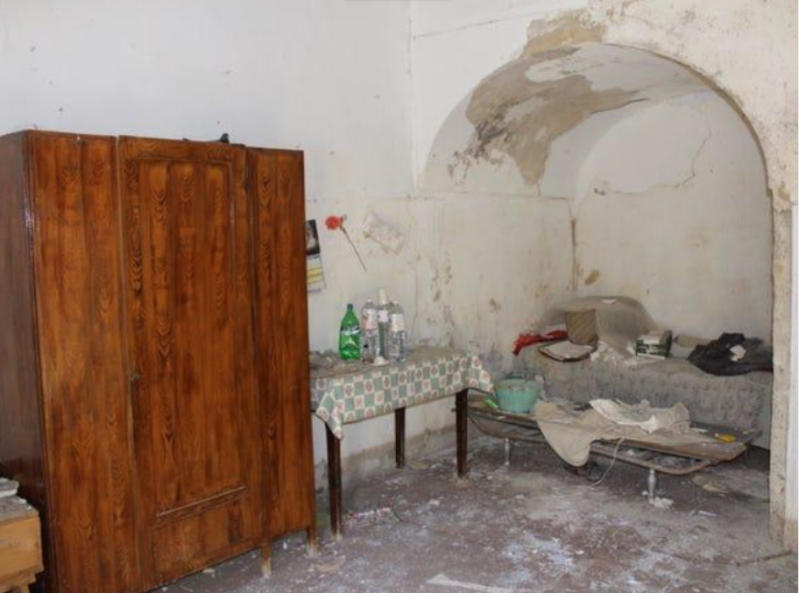
"The house needs renovating, but with a little work it will become a marvel." The problem is that the buyer has to pay for that work too—and isn't always willing to do so.
There is a scene that plays out frequently in the real estate market. An apartment with 1970s flooring, wiring and plumbing that need redoing, an original bathroom, and window frames that have seen better days. The owner shows visitors around and, with a certain enthusiasm, explains: "Here, you just need to change the floor." "The kitchen can be left as it is, maybe with a nice coat of paint." "The bathroom is still good; it just needs fixing up." And then comes the line meant to win everyone over: "With a renovation, it becomes a gem." Certainly. But who pays for the renovation? This is the question that is often missing in property valuations.
The value of a house is not its value after renovations A property in need of renovation can have great potential. It may be in an excellent location, offer generous square footage, a terrace, a panoramic view, or a layout that allows you to create a modern, functional home. Yet potential is not an already achieved result. If a buyer purchases an apartment requiring major work, they must factor in not only the purchase price, but also the expenses needed to make it habitable according to their needs. And it isn't just a matter of choosing more modern flooring or a designer kitchen. Work may be required on electrical and plumbing systems, windows, bathrooms, wall coverings, and in some cases even structural elements or room layouts. The value of a renovated home cannot automatically be attributed to a home that still needs to be renovated.
"But I spent a fortune on it" Another very common phrase. The owner remembers how much they paid for the property, how much they spent over the years, and how much it cost to maintain it. All understandable. However, the real estate market is not a reimbursement of expenses incurred. If you bought a house for €200,000 and today want to sell it for €250,000, it is not enough to explain that in the meantime you invested another €50,000. One must understand what was actually done, how much value it genuinely added, and what alternatives a potential buyer has today. A renovation can increase a property's value, though not necessarily in proportion to the money spent. And if the work is now dated, the market may not recognize any significant added value at all.
The buyer is not purchasing your memories Here another very delicate aspect comes into play: sentimental value. For the owner, that house may represent an entire lifetime. It may be the home where their children grew up, the one bought with a lifetime's savings, or the place where unforgettable moments were shared. Yet the buyer is not purchasing those memories. They are purchasing a property with specific features, in a specific location, at a specific price. They can appreciate its charm, history, and potential. But they are not obliged to financially reward what holds personal value for the owner. And this distinction, however harsh it may seem, is essential to approaching a sale with realistic expectations.
The asking price must also account for the works Imagine an apartment that, once renovated, could have a market value of €250,000. The owner decides to sell it for €230,000 because, in their view, that is already a bargain. Yet the buyer has to take on a substantial sum in renovation costs, in addition to closing fees and potential unforeseen expenses. At that point, the question becomes unavoidable: why buy a fixer-upper at a price so close to that of a move-in-ready home? Naturally, actual value depends on many factors: area, size, condition, features, and demand. But the principle is simple: the purchase price must be consistent with the property's current condition, not merely with the outcome that could be achieved after renovations.
Photographs cannot work miracles There is another issue as well. Some real estate listings try to enhance properties needing renovation through unrepresentative photos, descriptions that downplay flaws, and phrases like "property to customize" or "excellent investment opportunity." Calling a fixer-upper an opportunity does not automatically make it a good deal. A property can have great potential, but it must be presented transparently. The buyer must be able to understand the condition of the home and evaluate whether the asking price aligns with the necessary works. Good marketing is not meant to hide problems. It is meant to showcase the property's true potential without creating expectations that cannot be met.
The real mistake is confusing potential with value A home in need of renovation can be an excellent purchase. It can allow you to create a tailor-made living space, make the most of an attractive location, or develop a real estate project. For this to happen, however, the financial terms must make sense. The price must leave room for the required works and reflect the property's actual condition. Otherwise, potential remains nothing more than a promise. And a promise alone will not convince a buyer to invest their money.
Must the owner lower their expectations? Not necessarily. First, they need to understand what their house is genuinely worth in its current condition. If the asking price is justified, there is no reason to lower it simply because the property needs work. If, however, the market does not respond, viewings do not turn into offers, and buyers keep choosing other homes, then it is time to rethink the sales strategy. It is not enough to say the house is a gem. You have to prove why it should be one for the buyer too.
And you—how much would you pay for a fixer-upper? Are you willing to invest in a property to transform completely, or do you prefer buying a move-in-ready home, even at a higher price? And above all: in your opinion, should an owner factor in the cost of necessary renovations when setting the sale price? Domus Sicilia Immobiliare – Dimore e Terreni
Add comment
Comments