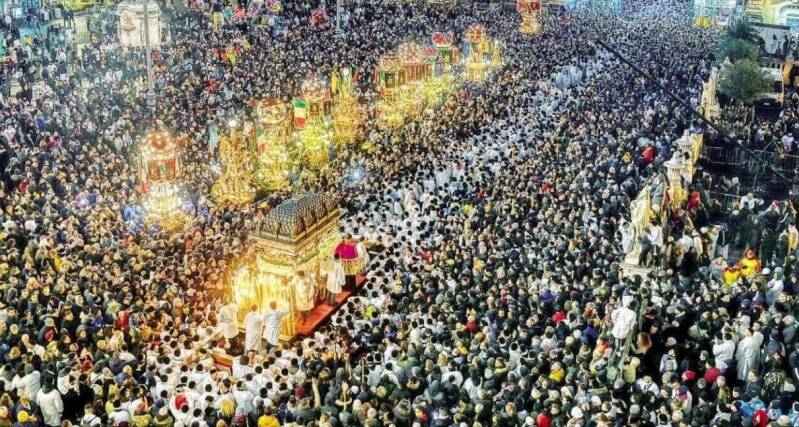
While the previous days build a crescendo of anticipation, February 5th represents the beating heart of the bond between Catania and its Patron Saint. This is the day when Saint Agatha traverses the historic center, passing through the most elegant streets and ancient quarters in an embrace that often lasts until the first light of the following dawn.
A Baroque Stage
On this day, the beauty of the noble dwellings and Baroque churches reaches its peak. Wrought-iron balconies, supported by ornate masks (mascheroni) carved into lava stone, transform into privileged grandstands. It is a moment of rare aesthetic harmony: the silver of the fercolo (the float) reflects the black and white stone of the palaces, creating a play of light that only Catanese Baroque can offer.
Two moments, in particular, remain etched in the hearts of those who watch:
-
The Salita di Sangiuliano: A breathtaking display of strength and coordination where devotees pull the silver float at a run up the steep incline of the street, defying gravity under the gaze of thousands of spectators overlooking from the terraces.
-
The Chant of the Benedictine Nuns in Via Crociferi: In the silence of one of the most beautiful streets in the world (a UNESCO World Heritage site), the cloistered nuns sing an angelic chant from behind their grilles. It is a magical contrast between the roar of the festival and the absolute peace of the sacred architecture.
Who is Agatha to Catania?
Closing this narrative without speaking of the woman behind the myth would be impossible. To the people of Catania, Agatha is not just a religious figure, but an ever-present "lady of the house" and an untiring protector.
Living in the 3rd century AD, Agatha was a young Catanese noblewoman of extraordinary beauty and firm will. In an era of persecution, her refusal of the Roman proconsul Quintianus was not only an act of faith but a gesture of extreme freedom and resistance. Subjected to atrocious martyrdom—remembered today by the famous "Minne" and "Olivette" pastries—she never bowed her head.
A Protector Amidst Lava and History
Why are the people of Catania so devoted to her? Because Agatha is the force that challenges nature. For centuries, citizens have invoked her veil to halt the lava flows of Mount Etna that threatened their homes and lands. In every historic manor, in every garden on the slopes of the volcano, there is a sign of this protection.
Agatha is the "Santuzza" (the Little Saint) who holds the keys to both the houses and the hearts of Catania. To a citizen, she is a sister and a queen; the one who reminds everyone that, despite destruction, Catania always has the strength to rise from its own ashes, more radiant than before.
Conclusion: Living the Legend
Experiencing the Feast of Saint Agatha means understanding the essence of Sicily. For us at Domus Sicilia, recounting these days means honoring a territory where beauty is eternal and faith is unshakable. Owning a property in this land is not merely a real estate investment; it is an act of belonging to a legend that, every February, returns to illuminate the lava stone with the brilliance of gold and silver.
Add comment
Comments