When visiting a historic property in Sicily, there is a precise moment when you stop looking at just a house and begin to travel through time. Ancient manor houses, rural farmhouses, and period palaces were not built following standardized logic, but contain fascinating architectural secrets designed centuries ago for logistical, survival, or climate management reasons.
Knowing how to read these details hidden within the stone walls is not just an exercise in curiosity, but represents an invaluable value driver when deciding to purchase and enhance a property with a strong historical character. Let’s discover the elements that make up the true "secret heart" of Sicilian homes.
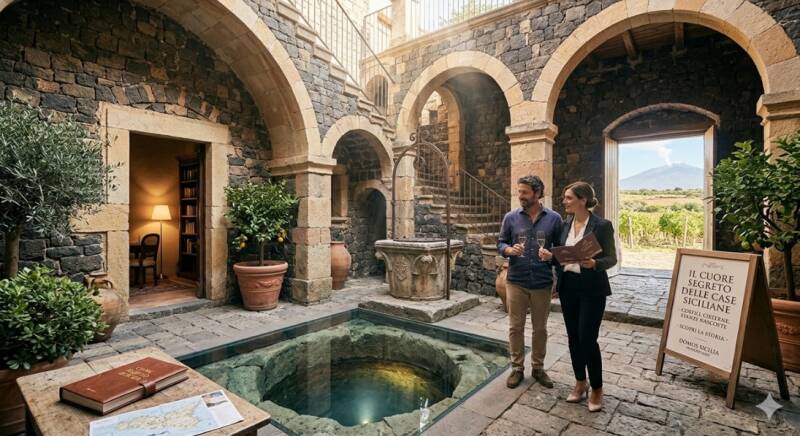
1. Inner Courtyards and "Bagli": The Hub of Life and Security The inner courtyard—or the "baglio" in larger, rural structures—was not merely a concession to aesthetics. It was the house's true engine. Designed as a space protected from the outside, it guaranteed the safety of the family and the farm workers against incursions. At the same time, the courtyard performed a fundamental bioclimatic function: it captured cool air during the night and created a ventilated shaded area for the hotter months. Today, during renovation, these spaces lend themselves to spectacular transformations. An ancient courtyard can become a private winter garden, an exclusive relaxation area, or house a stunning infinity pool framed by lava stone or limestone walls, while maintaining the property’s original privacy.
2. Ancient Rock-Hewn Water Cisterns In a land historically arid and sun-drenched like Sicily, water has always been the most precious commodity. For this reason, almost every independent historic home hides a monumental cistern for rainwater collection beneath the floor of the courtyard or the main rooms. These cisterns, often entirely hand-dug into the rock or living lava stone, are masterpieces of hydraulic engineering from another era, with perfect vaults plastered with cocciopesto (an ancient Roman waterproof mortar) to ensure impermeability. During modern restoration, these underground structures should never be filled in: illuminated with submerged LED lights, they can be transformed into private cellars for aging fine wines or even converted into evocative underground spa and hot tub areas.
3. Secret Rooms and Escape Cavities The most mysterious charm of Sicilian dwellings is linked to the presence of hidden passages and secret rooms. It is not rare, during technical surveys of noble palaces or ancient estates, to notice that external measurements do not match internal ones. These architectural voids often reveal the existence of:
-
Escape or refuge rooms: Small spaces hidden behind fake wardrobes, fireplaces, or movable walls, used in past centuries to hide during riots, pirate incursions, or regime changes.
-
Ventilation cavities: Empty spaces created specifically around master rooms to insulate them from ground humidity and keep the halls cool even during the most scorching summers. Finding and mapping a secret room during an inspection adds a component of pure real estate storytelling that deeply fascinates enthusiasts and collectors of period properties.
Giving History a Future with Domus Sicilia At Domus Sicilia Immobiliare, we have a profound respect for the island's architectural traditions. We believe that selling or buying a historic home is not a common commercial transaction. It requires the sensitivity to recognize historical value, the technical capacity to evaluate structural conditions, and the market vision to understand how to transform the past into a contemporary luxury investment. If you are looking for a house with a story to tell, or if you own a period property and wish to enhance its value in the market by trusting those who truly understand its soul, we are ready to assist you. Explore the hidden charm of our territory. Contact Domus Sicilia Immobiliare.
Add comment
Comments