There are places where history is not just told in books, but can be touched with one's hands, breathed in through lava stone, and revealed behind the imposing walls of ancient fortresses.
We at Domus Sicilia – Dimore e Terreni live every day immersed in the beauty and richness of our land. For this reason, we have decided to give you (and ourselves) a regular feature that will keep us company over the coming weeks: every Monday, for 10 weeks, we will take you to discover the 10 most extraordinary castles in the province of Catania.
From Norman manors perched on rocks to Frederick-era royal residences in the heart of the city, passing through volcanic strongholds and historic homes, we will explore the stories, secrets, and practical information to visit these extraordinary monuments.
Let's begin this journey in the beating heart of Catania, with one of Europe's most famous medieval monuments: Castello Ursino.
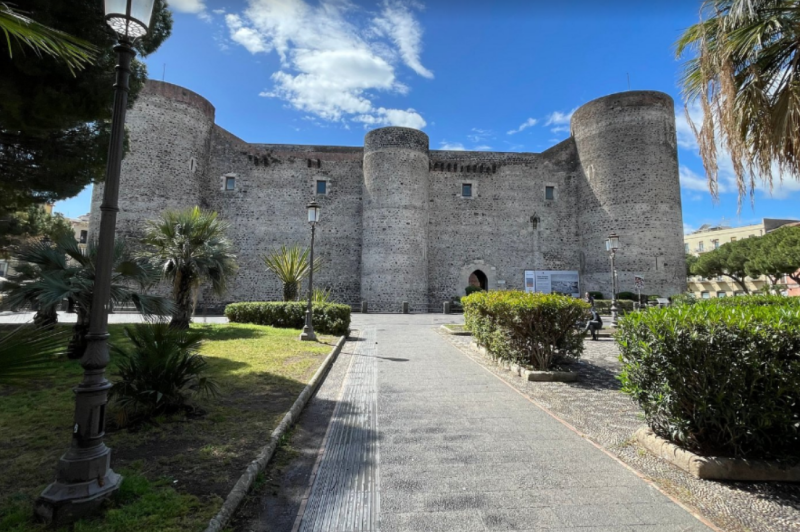
1. Castello Ursino (Catania): Frederick II's Giant That Defied Lava and Time
Imposing, austere, and incredibly fascinating, Castello Ursino dominates the historic center of Catania. Built in the 13th century (between 1239 and 1250) at the behest of Emperor Frederick II of Swabia, this castle represents one of the masterpieces of Frederickian military architecture in Italy.
The History: From Sea Fortress to Guardian of the City
Few know that, originally, Castello Ursino did not stand in the heart of the city as we see it today, but rather on a rocky promontory overlooking the sea. Its strategic position defended the gulf and access to Catania. The castle's appearance changed drastically due to nature and the fury of Mount Etna: during the devastating eruption of 1669, lava flows surrounded the fortress and even reached the sea, pushing the coastline hundreds of meters away and leaving the castle "isolated" right in the middle of the urban fabric. Over the centuries, it has served as a residence for Viceroys, a parliamentary seat, a prison, and today, a treasure chest of art and culture.
The Architecture
The castle has a strictly geometric plan: a perfect square with four mighty cylindrical corner towers and median towers along the sides. A structure designed to withstand attacks and symbolize the undisputed power of the Swabian crown.
Practical Information for Your Visit
If you want to plan a visit to Castello Ursino, here is what you need to know:
-
What it houses today: Inside is the Civic Museum of Catania, which preserves a rich collection of archaeological finds (Greco-Roman), sculptures, inscriptions, and a picture gallery with valuable works from the Renaissance to the 20th century, as well as regularly hosting major temporary exhibitions.
-
Opening hours: Generally open every day (it is always advisable to check any seasonal or holiday variations on the official channels of the Municipality of Catania or the museum). Typical hours cover the daily slot from 9:00 AM to 7:00 PM (last entry usually one hour prior).
-
Tickets: A standard admission ticket is required (with discounts for students, residents, or eligible groups).
A journey that starts from afar, then, to remind us how much our land is the custodian of an inestimable heritage.
Next Monday our column will continue: which fortress among those in the province do you think we will explore? (A clue: get ready to look at the sea from a spectacular basalt rock...)
Add comment
Comments