Before water comfortably reached homes through the public supply network, wells, cisterns, and rainwater collection systems were an indispensable resource for daily life in Sicily.
In many homes, especially in the countryside and small villages, the cistern represented a true water reserve. It was used to face long periods of drought and made it possible to store the water collected during the rains.
What were cisterns used for?
Cisterns were used primarily to collect and store rainwater.
Water coming from the roofs was channeled through gutters and pipes into the cistern, where it could be kept for several months.
That water was used for numerous daily necessities: for washing, cleaning, irrigating vegetable gardens, and, when properly treated, even for some domestic uses.
In a land like Sicily, where water has always been a precious resource, having a cistern meant having a small reserve of life.
The cleaning of wells and cisterns
The maintenance of the cistern was fundamental.
Periodically it was necessary to empty it completely, remove the sediment that had accumulated at the bottom, and clean the internal walls.
Over time, in fact, dirt, sand, leaves, and other materials carried by rainwater could settle at the bottom.
Cleaning was carried out with great care, because a dirty cistern could compromise the quality of the stored water.
In some cases, traditional systems were also used to limit the presence of small animals and insects in the water.
Grass snakes in the cisterns
And this is precisely where a curious tradition told in certain areas of Sicily originates.
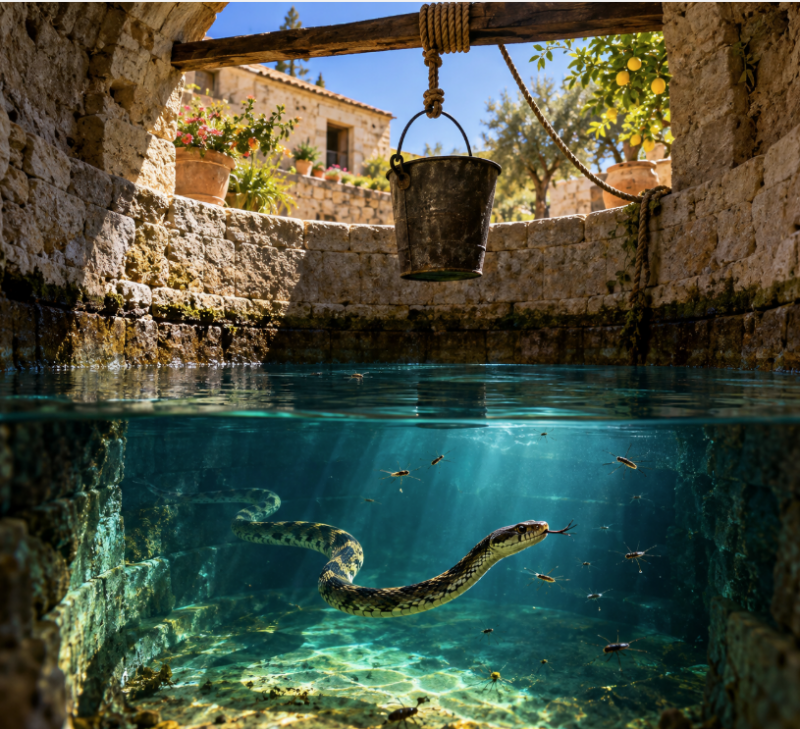
It is said that small grass snakes were left inside the cisterns to feed on insects, larvae, and other small organisms present in the water.
Their presence was therefore also associated with a sort of natural insect control function.
Naturally, not all cisterns were managed the same way, and this custom belongs mostly to memory and popular tradition, handed down orally from generation to generation.
From cisterns to legends
Numerous popular stories also grew around wells and cisterns.
They were deep, dark places, often inaccessible to children. For this reason, in adults' stories, they could easily transform into mysterious places inhabited by fantastic creatures.
One of the best-known figures is the Marabecca, a creature of Sicilian folklore associated specifically with wells and cisterns.
Telling children that the Marabecca lived inside the well was also a way to keep them away from dangerous places: an ancient form of education through fear and imagination.
When a well was more than a well
Today we look at an old well or cistern and simply see an ancient structure.
For those who lived in Sicily many decades ago, however, that place had a completely different significance.
It was a water reserve, a daily necessity, a fundamental element of the house and the countryside.
And around that water, a small world developed, made up of traditions, trades, practical arrangements, and legends.
The grass snake moving in the water, the sound of the bucket lowered into the well, the periodic cleaning of the cistern, and the stories told by grandparents to their children are fragments of a Sicily that today risks being forgotten.
Between history and legend
This is precisely the charm of Sicilian tradition: reality and fantasy often walk hand in hand.
A cistern where water was stored could become, in popular imagination, the home of the Marabecca.
A grass snake actually present in the water could turn, in the tales passed down to children, into a mysterious creature.
And a simple well could become the border between the everyday world and that of legends.
This is why preserving these stories means preserving a part of Sicily's memory.
Add comment
Comments