When you decide to sell or buy a home, one of the first documents shown is the cadastral floor plan. You often hear: "Look, the layout is identical to the house, so we’re all set."
Unfortunately, under Italian law, this is not enough. There is a fundamental distinction between the Land Registry (Catasto) and the Municipality (Comune) that every owner should know to prevent a sale from falling through right before the closing.
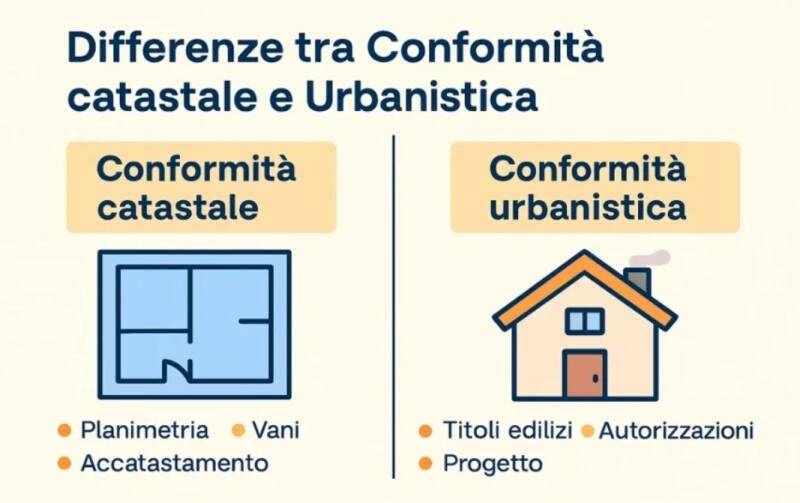
1. Cadastral Conformity (The Fiscal Aspect)
The Land Registry (Catasto) is an office of the Revenue Agency. Its primary function is fiscal: it serves to determine how much tax you must pay on that property.
-
What it’s for: It identifies the property, its category (as seen in previous articles), and its tax yield (rendita).
-
The limitation: The fact that a modification (e.g., knocking down a wall to create an open space) is shown on the cadastral plan does not mean that modification was authorized from a construction standpoint.
2. Urban Planning Conformity (The Building Aspect)
This is where the Municipality (Comune) comes in. Urban planning conformity is the correspondence between the actual state of the property and the building permits (building licenses, concessions, SCIA, CILA) filed in the municipal archives.
-
Why it takes precedence: The Municipality decides what can be built or modified. If a partition wall was removed without notifying the Municipality, the property has a building violation (abuso edilizio), even if the cadastral plan is "updated."
-
The risk: Without urban planning conformity, the property is not correctly marketable, and the notary may refuse to sign the deed.
The Paradox of "Updated Registry but Irregular Building"
This is a very frequent situation: in the 80s or 90s, cadastral changes were made to update plans, but the relevant practices were never filed with the Municipality. The result? You have a floor plan that looks perfect, but the property is technically irregular.
What to check before selling:
-
The Building Permit: Is there a project approved by the Municipality that matches the house?
-
The Certificate of Occupancy (Agibilità): Does the property have the document certifying its safety and hygiene?
-
Survey and Floor Plan: Do they match both the Municipality and the actual reality?
Why rely on Domus Sicilia?
Our job is not just to match supply and demand, but to ensure the transaction takes place in total safety.
"Selling a home or land without verifying urban planning conformity is a huge risk. A small irregularity can turn into a legal nightmare or a heavy price devaluation."
Before putting your property on the market, we perform a complete documentary screening. If there is a discrepancy between the Municipality and the Land Registry, we help you resolve it with the right technicians before it becomes a problem in front of the notary.
Add comment
Comments